
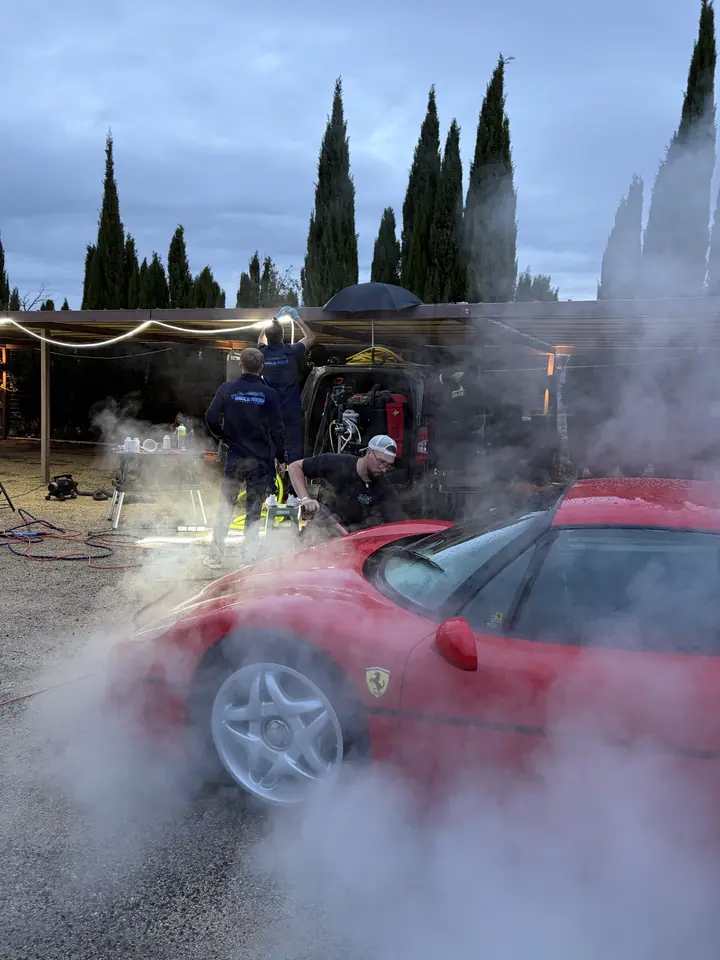
Steam cleaning a Ferrari F50
How steam works
Hot steam softens and lifts dirt: stuck-on dust, road film, greasy marks, residue in the corners. Once lifted, those deposits come away with a single pass of microfibre, with no need to rub.
It also has a sanitising effect on cabin surfaces, where hands, feet and food leave their mark.
Advantage 1: less rubbing on the paint
Micro-scratches come mostly from one movement: rubbing abrasive dust against the clear coat. By dissolving dirt before wiping, steam limits that risk. It is especially valuable on dark colours, where every scratch shows in the sun.
Advantage 2: the corners
Grilles, vents, seals, seat rails, air vents, stitching: steam reaches places a sponge or cloth cannot. Combined with a soft brush, it deals with embedded dirt.
That is also what makes it useful inside, as on the interior cleaning page.
Advantage 3: one method, inside and out
The same machine handles the bodywork, wheels, mats and plastics. For a mobile workshop that is a real asset: all the equipment fits in the van, and the car is treated on site.
The limits: where to hold back
Steam is not used the same way everywhere:
- Screens and electronics: never direct steam. A dry or barely damp microfibre is enough.
- Alcantara: very little moisture, a soft brush, and immediate drying.
- Leather: steam helps cleaning, but leather must then be wiped and fed by hand.
- Seals and hoods: never soaked.
What steam does not do
Steam cleans; it does not correct paint. Micro-scratches, light oxidation or a dull clear coat call for polishing and glazing, then a protective wax.
Glazing costs €400 incl. VAT, polishing from €700 incl. VAT per day: see polishing and glazing.
Steam on wheels and wheel arches
Wheels collect stubborn dirt: brake dust, tar, road film. Steam softens it, then dedicated brushes reach inside the spokes and around the nuts. Calipers, often painted, are cleaned without a hard brush.
Wheel arches are done separately, so that dirt never ends up back on the paint.
Inside: mats, plastics, air vents
In the cabin, steam is mostly used where dirt gets embedded: carpet, mats, lower door panels, cup holders, air vents. It lifts what a vacuum misses, before a microfibre wipe.
It is used sparingly: the aim is to clean, not to make the cabin damp.
Why skill matters more than the machine
A steam machine does not do the work on its own. You have to judge the distance, the time and the moisture for each surface, then wipe at the right moment.
That is the difference between steam that protects the car and steam that leaves marks or soaks a seat. At Unick Wash, Nicolas does every job himself, by hand.
Steam, then the hand
The result comes from the two together: steam prepares, the hand finishes. Every surface is wiped, every material gets its product, and the bodywork is dried with microfibre, streak-free.
All our packages use this method, from €200 incl. VAT for a saloon: see our prices.
Need a hand?
Nicolas takes care of it, at your place
Describe your car and what you need: slot and price confirmed within 24 hours, before the job.
Questions
In short
Does steam damage leather?
No, if it is used sparingly and wiped straight away; the leather is then fed by hand.
Can steam be used on a screen?
No. Screens and electronic controls are cleaned with microfibre, never direct steam.
Does steam remove scratches?
No. It cleans without creating new ones, but an existing scratch calls for polishing.