
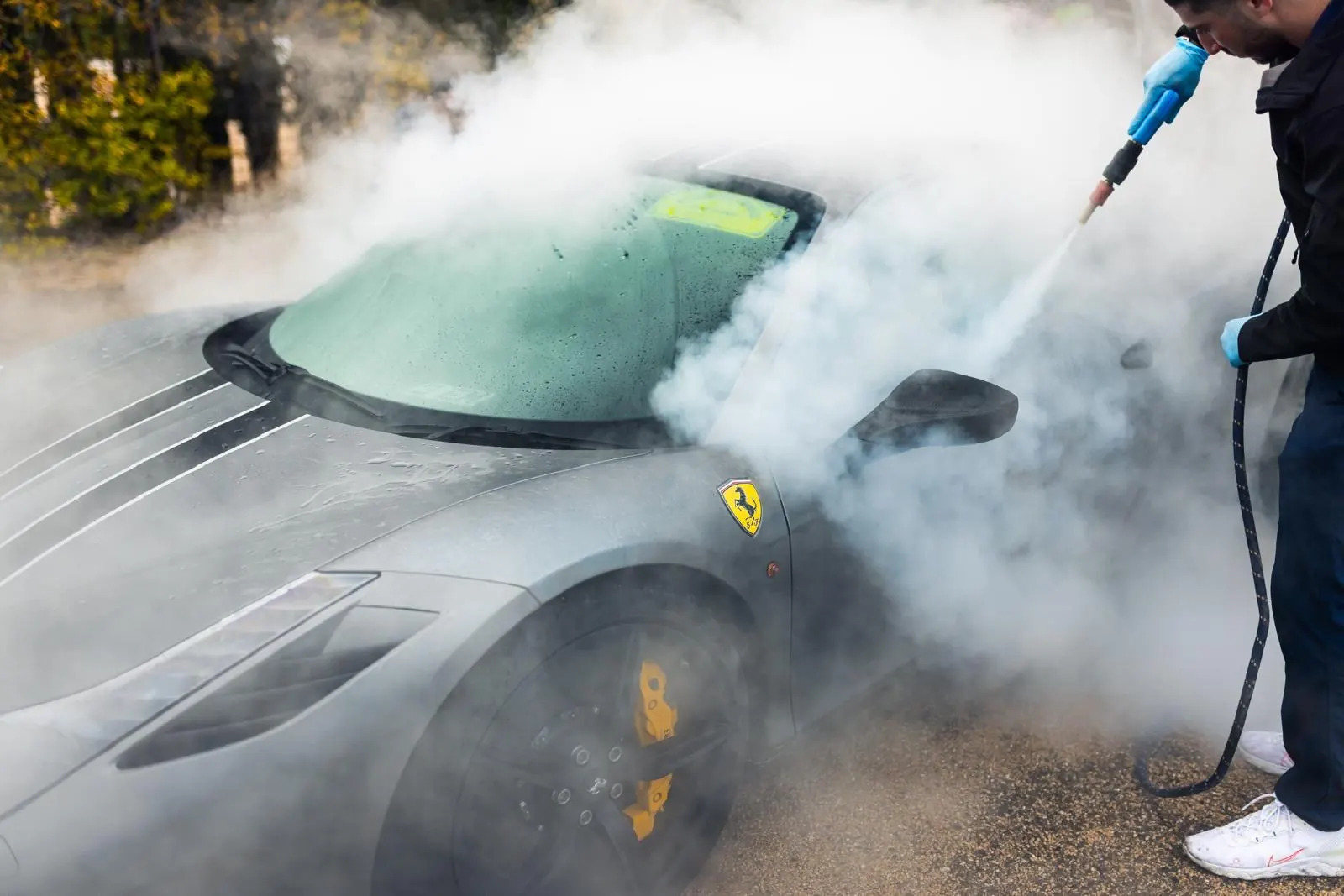
Steam detailing on a Ferrari, on site
The wash: making the car clean
A wash removes visible dirt: dust, mud, road marks. It is quick, often at a car wash, with rollers or a lance. It is useful to keep a car tidy between more thorough treatments.
Its limits are well known: rollers and gritty sponges can leave micro-scratches, corners often stay dirty and the cabin is left out.
Detailing: treating every part
Detailing goes over the car part by part, inside and out. Bodywork, wheels, tyres, glass, but also door sills, seals, air vents, seat rails and door cards. Each material gets the product and the touch that suit it.
The aim is not just cleanliness: it is appearance. Leather that is fed, alcantara with its nap back, glass with no haze, paint that reflects the light again.
The method changes everything
In detailing, you avoid rubbing dirt dry across the paint. At Unick Wash, steam goes first: it dissolves and lifts the deposits, which then come away with clean microfibre. Drying is done by hand, panel by panel.
The same logic applies inside: vacuuming, steam on surfaces that can take it, then each material finished by hand. To see why, read about steam cleaning.
The cabin, forgotten by the wash
The difference shows most inside. A standard wash does not touch the mats, the seats or the steering wheel. Detailing does: deep vacuuming, plastics and inside glass, leather restored, steering wheel cared for.
Particular needs (sand, dog hair, a stained seat) are added as options. Everything is explained on the Interior cleaning page.
When to choose which
- A wash is enough to remove dust from a car that is already well kept.
- Detailing is the answer when the cabin has seen some use, before a sale, after a beach season, or for a prestige car whose paint and materials you want to preserve.
- They work together: regular detailing, and gentle upkeep in between.
The corners that make the difference
Open a door after a car wash: the sills, the seals and the bottom of the door cards are often still dirty. Yet these are the places you see every time you get in.
Detailing goes after those areas one by one: sills, hinges, seals, lower body, inner wheels, air vents. That invisible work is what makes a car feel “like new”.
Fine materials need their own treatment
A high-end car often brings several materials together within a few centimetres: leather, alcantara, carbon, brushed aluminium, piano black. Each reacts differently to moisture and products.
A wash does not make that distinction; detailing does. The steering wheel of an Audi RS6, alcantara and carbon, shows the logic well: two materials, two treatments.
Drying, the step people skip
A car left to air-dry fills with water spots, especially in the sun and on a dark colour. In detailing, drying is done by hand with clean microfibres kept for that purpose, panel by panel.
Mirrors, seals and wheels, where water keeps dripping, are done last to avoid runs.
Detailing at home
Detailing takes time, usually 3 to 4 hours for a complete clean. At home, that time costs you nothing: the mobile workshop sets up next to the car and you get on with your day.
The packages and their prices are on the Prices page.
Need a hand?
Nicolas takes care of it, at your place
Describe your car and what you need: slot and price confirmed within 24 hours, before the job.
Questions
In short
Is detailing gentler on paint than a car wash?
That is precisely its aim: no rollers, no dry rubbing, and steam that dissolves dirt before microfibre wiping.
Does detailing include the interior?
Yes. Our three packages treat the interior and exterior together.
How long does detailing take?
Usually 3 to 4 hours for a complete clean, depending on the package and the condition of the vehicle.